Winters Genealogy
The Barrer farm in Kilgarriff
The Barrer Farm in Kilgarriff, Co. Limerick
Kilgarriff is located in the parish of Ballingarry and was part of the Castle Oliver Estate during the period of the Barrers' tenancy. The name Kilgarriff is derived from the Irish *Coill Charbh*, meaning rough wood. Its name appeared as far back as 1654 in the Down Survey, in which it was called Keilgarruffs.
The first mention of the Barrer family in Kilgarriff was in 1829, when Thomas BARRER was recorded in the Tithe Applotment Book with a landholding of just over 10 acres (possibly Irish plantation measure, in which 1 Irish acre equalled 1.62 English acres). Thomas Barrer is again mentioned in 1831 as the recipient of 200 scotch, 200 spruce, 200 larch, 200 ash trees (detailed in the estate record "List of Trees Planted on Castle Oliver Estate in the year 1831 as given to Tenants").
At some time between 1831 and 1848 the tenancy of the Barrer farm passed from Thomas Barrer to his son George BARRER. A Tenure Book for Kilgarriff, compiled in 1848 in preparation for Griffith's Valuation, confirms that George Barrer was the tenant of the Castle Oliver Estate at that time. This was also the year that George Barrer married Eliza MEE. Importantly, the Tenure Book noted that the Barrer lease dated back to 1818 and that it was a lease 'at will' - an informal arrangement whereby the tenant occupied the land entirely at the discretion of the landlord. It had no fixed term and could be terminated by either party at any time. This was in contrast to a lease for lives which only expires when the last named life dies.
The Griffith's Valuation of 1852 details the Barrer farm as occupying just over 17 statute acres. The nature of the land was described in a valuation Field Book as "arable and pasture part cold, brown and black clayey soil on a yellow clayey subsoil." The farm is shown as plot 15 on the following map from the Valuation. The letter 'a' indicates the location of the house. The trees shown on the map are likely to have been those planted in 1831.
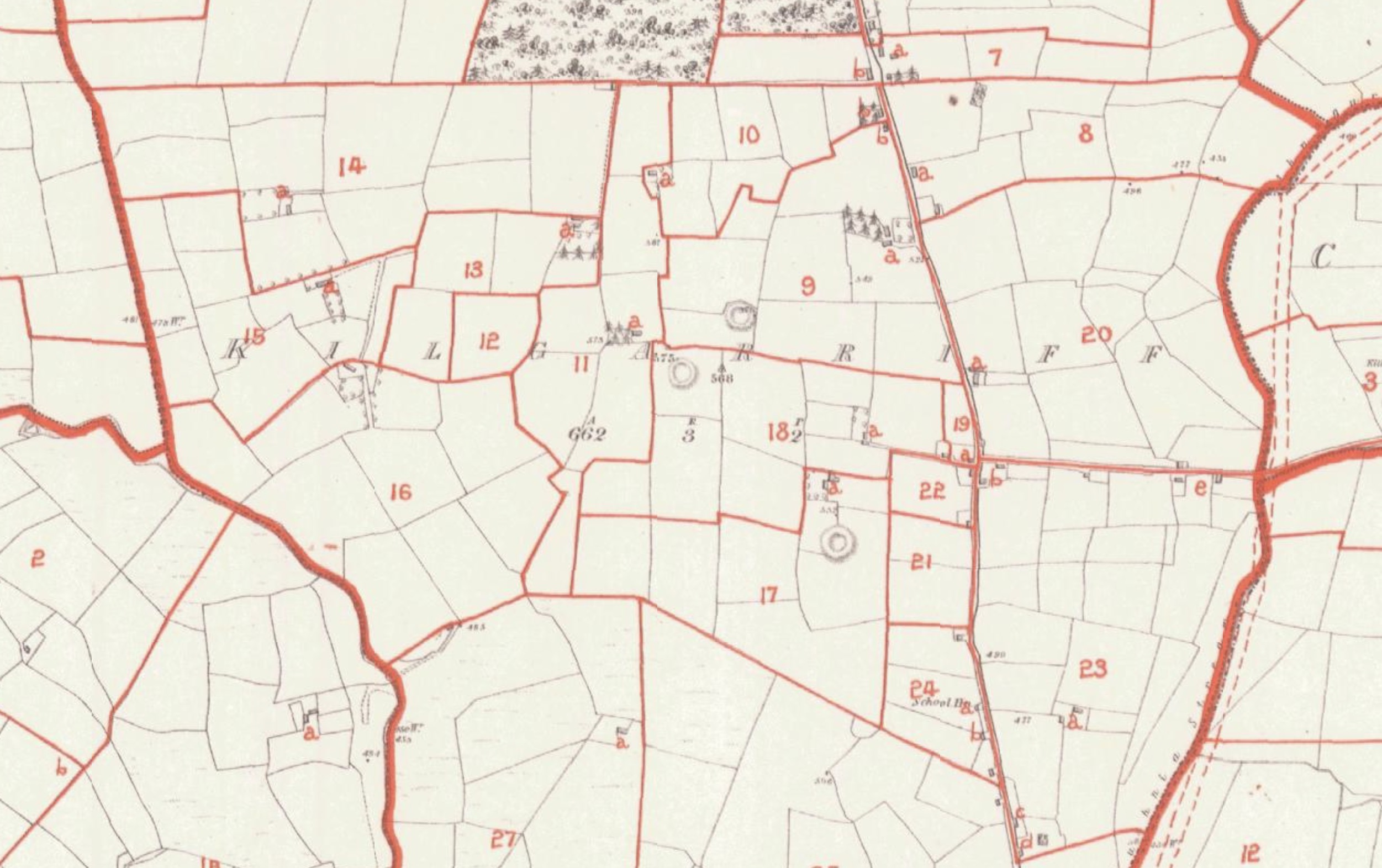
The exact dimensions of the house were given in the Valuation House Book of 1849 and were (in feet) 44.6 x 19.6 x 7.3. A stable and cow house were also mentioned. This is typical of an Irish farmhouse of the time, usually single storey, thatched, with a central living/kitchen area, a main bedroom to one side and one or two smaller bedrooms to the other side.
George Barrer continued to occupy the farm from 1848 until his death at Kilgarriff in 1904, after which the tenancy passed to his eldest son Thomas BARRER. It is not known if Thomas lived at the farm, and in 1907 a deed records the lease passing to a new tenant, Nicholas Condon, so ending the Barrer family's tenancy of the farm at Kilgarriff that had lasted for nearly 90 years from 1818. The census of 1911 shows George Barrer's widow Eliza nee Mee was living in Ballyorgan with their second oldest son John BARRER; she died there a year later in 1912.
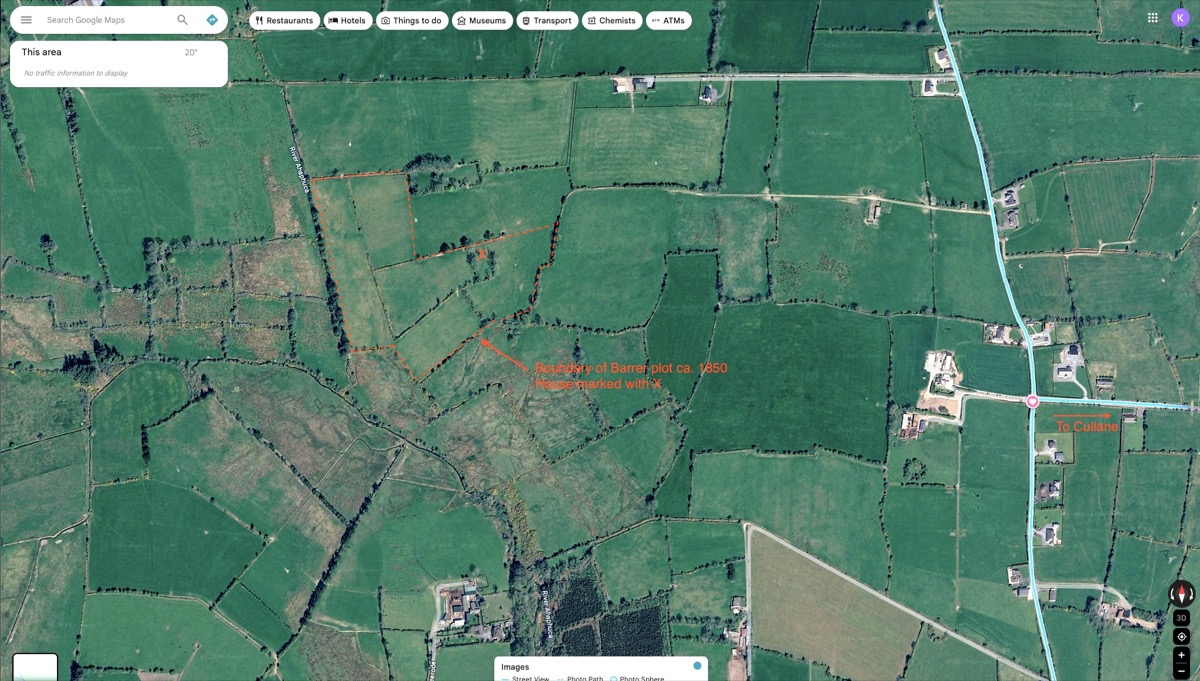
The farmhouse appears to have been demolished some time after the occupancy of the Barrers, and there is no sign of it on modern maps. However, the boundary of the farm, as shown on the Griffiths Valuation map of 1852, can still be discerned from the air. The old boundary has been outlined in the following screenshot taken from a Google Maps terrain view (ca. 2026); trees are still visible from where the house once stood, and may be survivors of those planted in 1831.